Analytical Art
Introduction | Concepts | Difference | History | Galleries
Concepts of Analytical Art
Main Concepts
Highlights of Filonov’s system
Ideology of Analytical Art, written by Pavel Filonov
Principles of working on an analytical painting, written by Yurii Tumanian
The very main concepts of the Analytical Art
• Non-programmed method of form-creating: conscious limitation of rational imagery
• From particular to whole
• From occasional to regular
• From flat to 3-dimensional
• From non-objective (abstract) to objective
• Artwork is constant flow of highest number of shapes
• The image is constructive/meaningful conclusion or emergence made out of simplest “atoms”
• In any object the inner phenomena define outer (visual) appearance and meaning
Highlights of Filonov’s system:
1. One must draw/paint in the state of tension of analytical intuition.
2. The tension should bring the image particles to the state of biological connection of particles in nature.
3. Working with the dot as a unit of action (although tension can be achieved using any size of unit).
4. The ability to work from the particular to the general/whole.
5. Work with the clear shape or form.
6. Working by the emergence, which means understanding of the main concept through the process (not from the beginning!) and finishing it by the ultimate development of parts of the image.
7. Colorful emergence, which is a tension of the whole painting by the sudden appearing of the new color.
8. Free treatment of time and space.
9. Paint any color using any color and any form, using any form.
10. Every master may work using systems: realistic; “made” primitive; abstract; using invented forms and combination of all of them.
Ideology of Analytical Art by Pavel Filonov (extract), 1930
A work of art is any piece of work made with the maximum tension of analytical madeness, or completeness. [Filonov invented a word, the closest translation of which would be “total completion”.]
The only professional criterion for evaluating a piece of work is its completeness.
In their profession the artist and his disciple must love all that is “made well” and hate all that is “not made/unfinished”.
The more consciously and forcefully the artist employs his mind and intellect, the stronger the effect the finished work has on the spectator.
Each brushstroke, each contact with the picture is a precise recording through the material, and in the material of the inner physical process taking place in the artist, and the whole work is the entire recording of the artist’s mind.
Art is the reflection through material (or the record in material) of the struggle for the formation of artist’s higher intellectual condition and of the struggle for existence by this higher psychological condition. Art’s efficacity vis-a-vis the spectator is equal to this; i.e., it both makes him superior and summons him to become superior.
The proletarian artist’s obligation is not only to create works that respond the demands of today, but also to open the way into the distant future.
The proletarian artist must aim at the intellect of his comrade proletarians not only through what they can understand at their present stage of development.
Work on content is work on form and vice versa.
The more forcefully form is expressed, the more forcefully content is expressed.
Form is made by persistent line. Every line must be made.
Every atom/particle must be made; the whole work must be made and adapted.
Think persistently and precisely of every atom of the work you are doing. Make every particle persistently and accurately.
Introduce persistently into every atom the color you have studied — so that it enters the particle just as heat enters the body or so that it is linked organically with the form, just as in nature a flower’s tissue is linked with its color.
Painting is the colored conclusion of drawing.
Taken from Russian art of the avant-garde: theory and criticism, 1902-1934 / edited and translated by John E. Bowlt.
Below is the spiritual and literal “manual” accompanying contemporary Analytical Art followers: the Canon of Analytical Abstractionism, which is a collection of principles and rules of work on analytical compositions. It was developed and written by Yurii Tumanian using the experience of abstractionism as practiced by Pavel Filonov. This is the simplified version of this work:
Principles of working on an analytical painting
1. The principle of the plastic value of the picture
The artistic value of the analytical work is completely determined by visual perfection of the created forms and composition from them. The content of analytical work is the plurality of meaningful or imaginary associations which are spontaneously invoked when perceived by prepared viewer.
2. Analytical principles
To analyze and to research
Non-programmed principle of form-creating
Support is on intuition and conscious limitation of rational fantasies
3. Constructive principles
Creation of complete mutual dependency of shapes
Unity of all the consecutive elements
4. The principles of color harmony
The interconnection and unity of all color components of work
Maintaining the dominance of form over color (color is not an independent means of expression, but is one of the characteristics of form)
The use of permanent harmonized color palette
5. The Principle of Maximalism
The work is formed as an uninterrupted flow of maximum number of different shapes
All parts of the work have an equal visual value, different parts of work have an independent visual value
The achievement of illusory fusion of color layer and shape
6. The Principle of Standardization
The canvas of all the students in one group should be of the same size to begin with
A standard technique of painting is utilized, consistent with the principles of analytical form-creation.
The following sequence is being held in the process of analytical form-creating:
Introspective shape-creating >>> understanding, interpreting, and finding the order >>> constructive/meaningful conclusion >>> volumetric transformation of emerging imagery. All of these lead the painting to the “absolute madeness”, absolute completion.
With all the principles and steps described here, the beginning of the analytical process may look something like this:
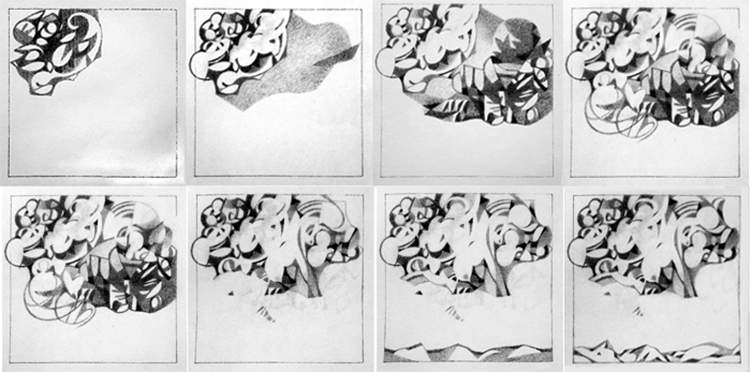
…and many, many more stages, until they lead you to the final conclusion.
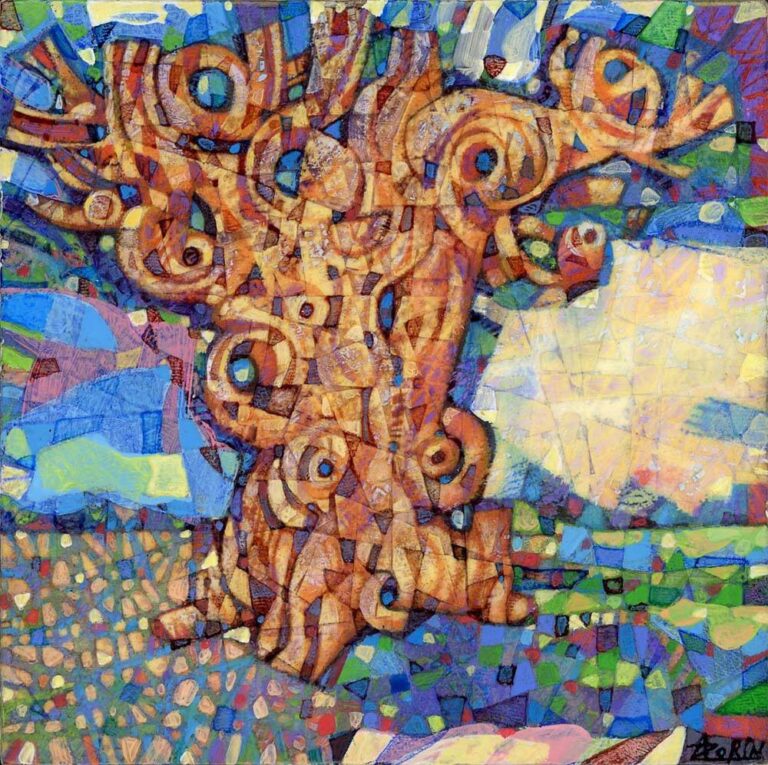
Filonov’s metaphors explaining his method:
Look and have an understanding of art not as to What, but How it is done. What is interesting is not the face of the clock, but the movement of the inner mechanism and progression of time.
In order to explain the processes taking place in an object, the next example is given:
It is possible by just watching the trunk, branches, leaves and flowers of the tree, at the same time to know, or, by analyzing, at least try to figure out how the tree’s juices are sucked out from the soil by its roots, then moved up and spread out according to the reaction on light and warmth.
Unfortunately, these days lots of people attempt to create Analytical Art by merely superficially examining some of Filonov’s work, and their ideas, or more precisely, assumptions are formed on the base of art’s appearance, not studying the creative process employed. Those superficial followers simply produce a regular basic image (flower, body etc.) and then dissect it into shapes. This is the exact opposite of the Analytical Art process.